
In industrial predictive maintenance, oil condition monitoring serves as the early warning system for rotating machinery, hydraulic systems, and lubricated equipment. It helps maintenance teams detect hidden faults, avoid unplanned downtime, and extend component service life. When analyzing lubricant and industrial fluid health, two core particle metrics always come into focus: particle count and particle size distribution.
Most on-site maintenance teams prioritize particle count first. It is the standard benchmark for judging oil cleanliness, widely adopted in ISO 4406 oil cleanliness grading and daily contamination control. But here is a critical industry truth many technicians overlook: particle count reflects how dirty the oil is, while particle size reveals what is wrong with your machine. For accurate fault diagnosis and predictive maintenance, particle size data is often more decisive than pure particle quantity.
Particle Counter: The Foundation of Oil Contamination Control
Particle count testing calculates the total number of solid particles in lubricants or hydraulic fluids, classifying particles into standard size thresholds (≥4μm, ≥6μm, ≥14μm) to generate standardized ISO 4406 cleanliness codes. It is the most intuitive metric to evaluate overall oil contamination levels, filter performance, and external pollutant ingress.
A stable particle count indicates effective lubricant management and a clean operating environment for equipment. A sudden spike in particle quantity usually means increased dust, debris, or residual impurities in the oil system. However, particle count has obvious limitations: it only shows the “pollution degree” without explaining the root cause.
High counts of fine microscopic particles may only represent mild contamination or oil aging, rather than mechanical wear. Relying solely on particle count will easily lead to over-maintenance, unnecessary oil replacement, and increased operational costs.
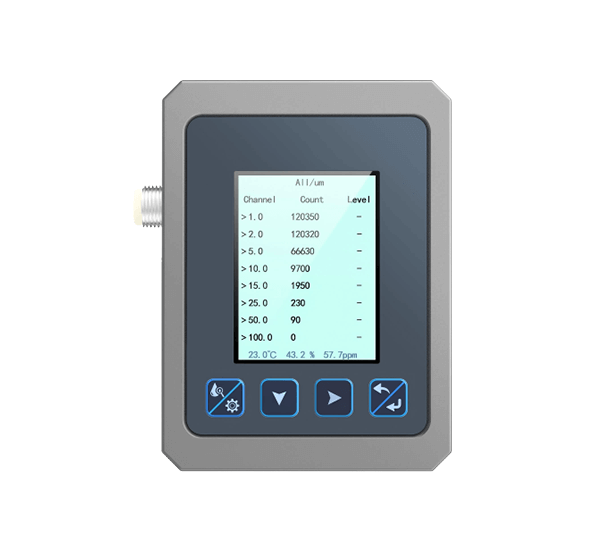
Particle Size Distribution: The Key to Identifying Equipment Wear Risks
Unlike particle count that quantifies overall contamination, particle size distribution directly mirrors equipment wear severity and fault types. In mechanical operation, fine particles are mostly produced by normal lubricant friction and aging, while large-sized particles are clear signals of abnormal mechanical failure.
The emergence of large particles typically indicates severe equipment problems, including surface fatigue, abrasive wear, component scuffing, bearing degradation, and gear tooth damage. These oversized particles break the lubricating oil film, aggravate internal friction of equipment, and trigger progressive component damage. If not detected in time, minor wear will quickly evolve into catastrophic equipment failure and long-term production shutdowns.
In many practical industrial scenarios, systems may show a moderate and stable particle count, seeming to operate normally. But once large particles appear continuously, it means hidden abnormal wear has occurred inside the equipment. This is the critical fault blind spot of single particle count monitoring.
Smart Oil Monitoring: Combine Count and Size for Full-Spectrum Health Assessment
The biggest misunderstanding in traditional oil analysis is choosing between particle count and particle size. The optimal industrial maintenance strategy is never an either-or choice, but organic integration of quantity and particle characteristics:
-
Particle Count: Tracks real-time oil cleanliness, optimizes contamination control, and judges filter and lubricant maintenance effects
-
Particle Size Distribution: Identifies wear fault types, monitors fault progression, and realizes early warning of potential equipment failures
-
Dual-data combination: Eliminates monitoring blind spots, avoids misjudgment and missed judgment, and builds a reliable equipment health database
Only by combining these two core metrics can maintenance teams move from passive “oil pollution inspection” to active “equipment fault prediction”, truly realizing efficient condition-based maintenance (CBM).
Yateks: Professional Full-Spectrum Oil Condition Monitoring Solutions
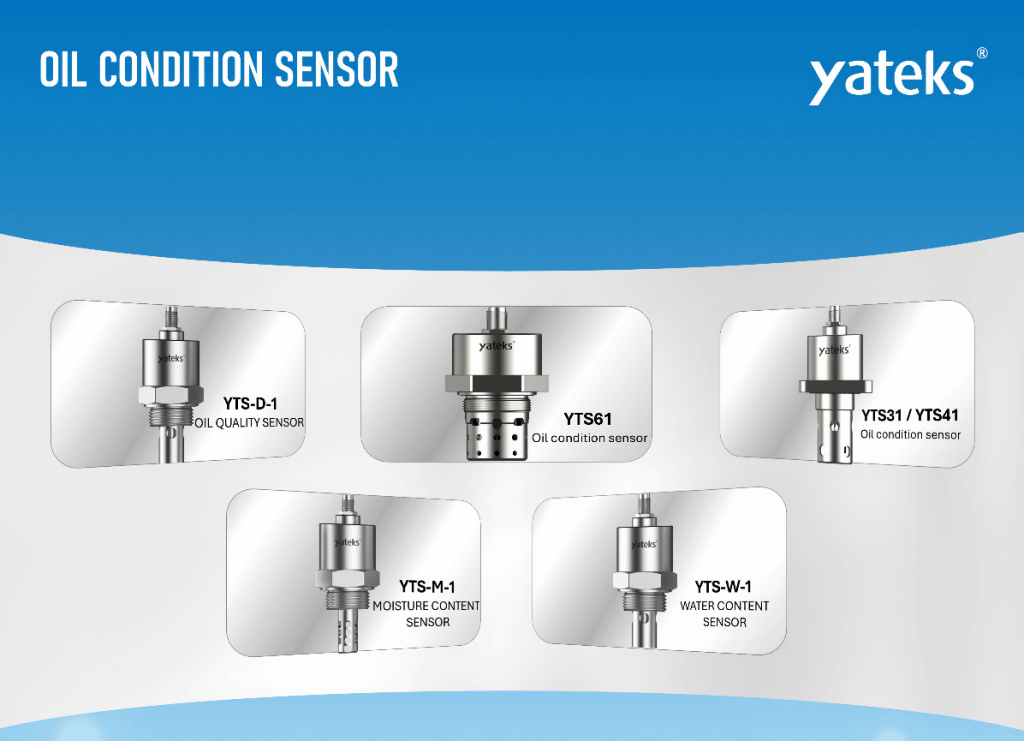
As a professional provider of industrial fluid analysis and equipment condition monitoring solutions, Yateks has long focused on solving the pain points of single-dimensional monitoring in industrial maintenance. Our portable and laboratory-grade oil analysis devices break the limitations of traditional single particle count testing, supporting synchronous high-precision detection of particle count, particle size distribution, oil viscosity, density, and temperature.
Equipped with advanced piezoelectric resonant MEMS sensing technology, Yateks oil monitoring equipment delivers accurate, repeatable multi-parameter data in seconds on-site. It no longer relies on tedious laboratory testing, helping enterprises:
-
Achieve real-time on-site oil quality and equipment health monitoring
-
Accurately distinguish normal contamination and abnormal mechanical wear
-
Optimize maintenance cycles, reduce unnecessary spare parts and labor costs
-
Effectively avoid unplanned downtime and extend equipment service life
Final Verdict
Particle count tells you how dirty your oil is; particle size tells you how healthy your machine is. For modern industrial predictive maintenance, neither metric is dispensable. Single-data monitoring is always incomplete — only full-spectrum particle feature analysis can truly decode the operating state of mechanical equipment.
Upgrade your oil monitoring strategy with Yateks, and turn passive maintenance into precise, efficient, and cost-saving proactive equipment management.