
What Is Oil Cleanliness Monitoring?
Oil cleanliness monitoring is a method of continuously or periodically evaluating the level of solid particle contamination in lubricating and hydraulic oil.
For industrial machinery, “clean oil” does not simply mean oil that looks clear. Microscopic particles may be present even when the fluid appears visually normal. Particle contamination can affect pumps, bearings, gears, valves, and other precision components.
Modern oil monitoring therefore focuses on measurable particle concentration, particle size distribution, and contamination trends rather than visual inspection alone.
ISO 4406 is one of the commonly used systems for expressing solid-particle contamination in hydraulic fluids. The standard uses particle concentrations at defined size ranges to produce a cleanliness code.
Why Does Oil Cleanliness Matter?
Contaminated oil can create a cycle of wear.
Particles enter the lubrication system and circulate with the oil. Some particles can pass through component clearances and contribute to abrasive or fatigue-related wear. The resulting wear can generate additional debris, increasing contamination further.
This means particle contamination can be both a symptom and a potential contributor to equipment degradation.
For high-precision hydraulic systems, this issue becomes particularly important because modern components can have very small internal clearances. Industry guidance increasingly emphasizes controlling particle contamination as part of hydraulic system reliability.
What Causes Oil Contamination?
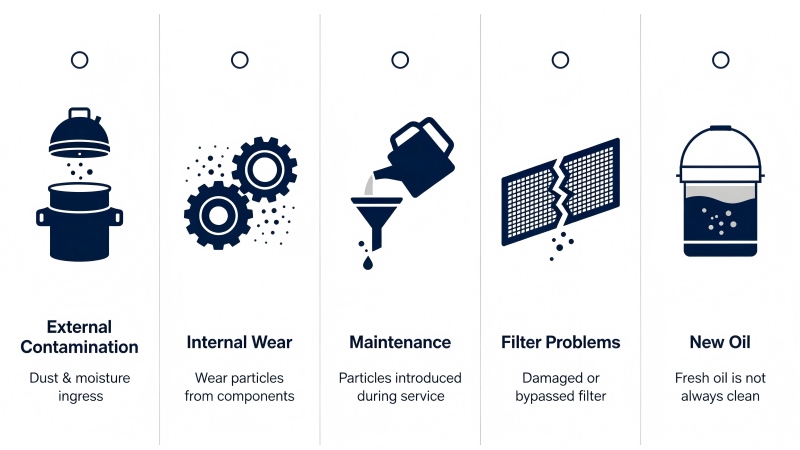
There is no single source of oil contamination. Common sources include:
- External contamination: Dust, dirt, moisture, and other environmental contaminants can enter through breathers, seals, maintenance operations, or open reservoirs.
- Internal wear: Bearings, gears, pumps, valves, and other components can generate metallic or non-metallic wear particles.
- Maintenance contamination: Improper cleaning during component replacement or oil filling can introduce particles into the system.
- Filter problems: A damaged, overloaded, incorrectly installed, or bypassed filter may allow contaminants to circulate.
- New oil contamination: Fresh lubricant should not automatically be assumed to be sufficiently clean for every application. Oil handling and filtration remain important parts of contamination control.
How Does an Oil Particle Counter Work?
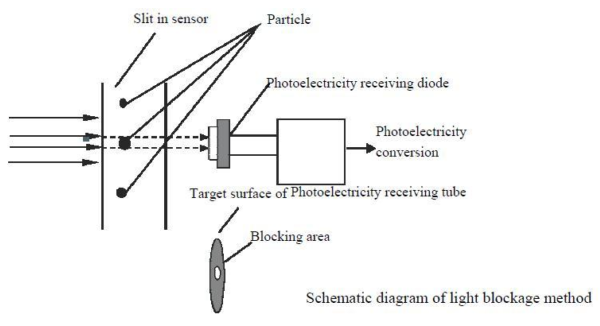
An oil particle counter detects particles as oil passes through a measurement zone.
One common technique is optical particle counting based on the light-blockage (photoresistance) principle: as a particle passes through a light beam, it temporarily reduces the light reaching the detector, allowing the instrument to estimate particle size and count.
This is exactly the approach used by the YFJ-4 Online Particle Counter Sensor. The YFJ-4 uses the light-blockage method to measure particle size and quantity distribution in real time, with signal processing designed to improve detection accuracy and data reliability.
What makes the YFJ-4 particularly practical for industrial users is its flexibility and connectivity:
- Dual calibration standards: The sensor can be calibrated to either ISO 4402 or ISO 11171, so your readings align with the cleanliness specification your application — or your customer — requires.
- Standard RS485 interface: The YFJ-4 integrates directly into existing PLC, SCADA, or condition-monitoring networks for reliable, long-distance data transmission.
- Wear trend analysis: Beyond raw particle counts, the YFJ-4 helps maintenance teams grasp and analyze real-time data and the wear trend of the hydraulic system — turning isolated readings into early warning signals.
This type of sensor is particularly useful when maintenance teams need quantitative, up-to-date information about oil contamination.
What Is an Online Oil Cleanliness Sensor?
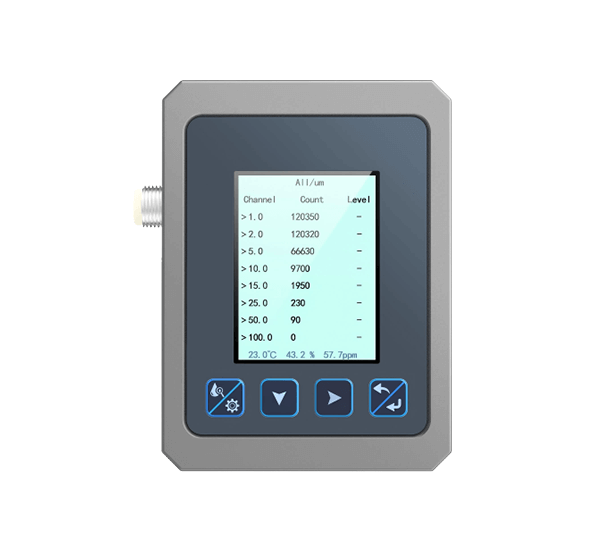
An online oil cleanliness sensor is installed directly into an oil circuit or monitoring system so that contamination can be measured without repeatedly removing samples for laboratory analysis.
Depending on the system design, online monitoring can provide:
- Particle concentration
- Particle size distribution
- Contamination trends
- Cleanliness classifications
- Real-time or near-real-time alerts
- Data for predictive maintenance
The major advantage is continuity.
Instead of receiving one measurement every few weeks or months, engineers can observe changes much more frequently. With the YFJ-4 installed online, sudden contamination events — a failing filter, a breached seal, abnormal component wear — can be identified while there is still time to act, rather than weeks later in a laboratory report.
Is Particle Counting Enough?
Not always.
Particle counting provides important quantitative information, but the number of particles does not necessarily reveal their origin.
For example, an increase in particle concentration could result from environmental contamination, filter failure, or mechanical wear. Additional information may be required to determine the likely cause.
This is why trend analysis matters. Instead of judging a single reading in isolation, the YFJ-4 lets you track how particle concentration evolves over time. A sudden spike suggests a contamination ingression event; a gradual, sustained rise often points to developing component wear. Combined with routine maintenance records, this trend view helps maintenance teams separate cause from symptom — and move from reactive repairs to predictive maintenance.
The Bottom Line
Your hydraulic system will always wear. The only question is whether you watch it happen — or get ahead of it.
With the YFJ-4 Online Particle Counter Sensor, you turn hidden contamination into visible, actionable intelligence: accurate particle counts based on the light-blockage principle, dual ISO 4402 / ISO 11171 calibration, plug-and-play RS485 integration, and real-time wear trend analysis that supports predictive maintenance.
Don’t wait for the next breakdown to tell you what your oil already knows. Contact us today to learn how the YFJ-4 can protect your equipment, reduce downtime, and extend the life of your hydraulic systems.