
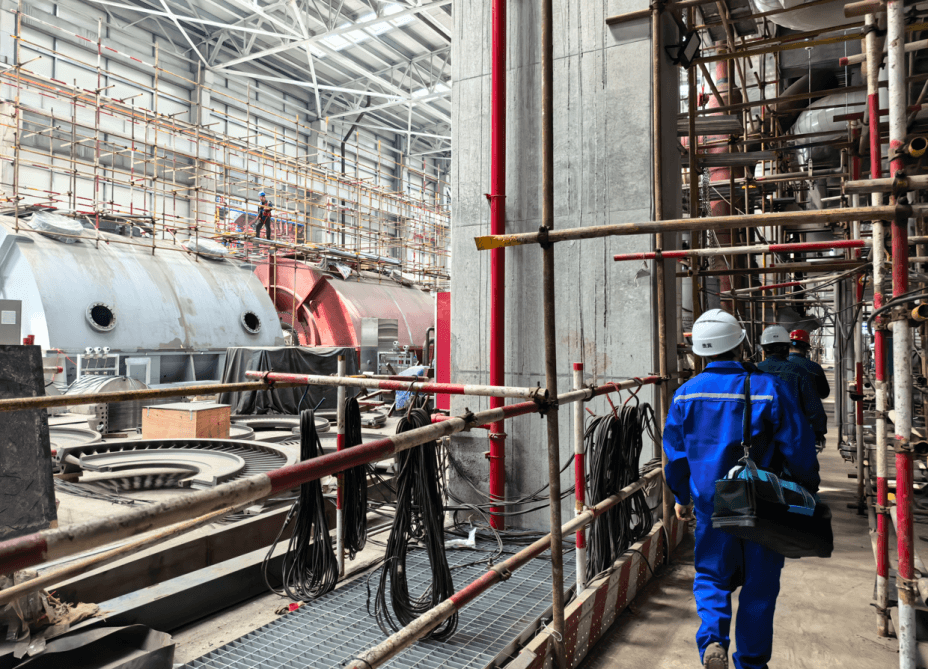
At a coal-fired power plant in northern Shaanxi, three critical fans — induced draft (ID), forced draft (FD) and primary air (PA) — share the same operating profile: long run hours, high load, and heavy dust in the airstream. When the units entered a scheduled outage, the plant made one request: install online oil monitoring on those fans so the shift crew could read oil condition on the spot instead of waiting for a laboratory report.
This case study covers what was installed, where the sensors went, what the seven live parameters actually tell an operator, and how the work was completed without extending the maintenance critical path.
Why a shutdown window is the only chance you get
Key units at a coal-fired plant rarely get a clean maintenance window. The schedule has to clear the generation plan, and every installation, cable run and commissioning step has to be finished before the unit goes back into service.
The project team treated “do not extend the maintenance critical path” as a hard constraint. Work was interleaved with the overhaul sequence rather than scheduled after it, and sensor mounting, cable routing and system commissioning were completed on the hydraulic reservoir of each fan before the unit returned to service.

The real problem: a lab report that arrives a hundred hours late
Oil condition used to be judged through the plant’s oil laboratory on a fixed sampling cycle: take the sample, dispatch it, wait in the queue, receive the report. By the time the result reached the shift crew, the machine had often run another hundred hours or more.
Feedback from the floor was blunt: laboratory turnaround was too slow to be useful.
For a fan running long hours at high load, that gap is exactly where a developing problem gets amplified. Oil degradation rarely happens instantly. It drifts from a point, and by the next scheduled sample the oil may already have travelled a long way.
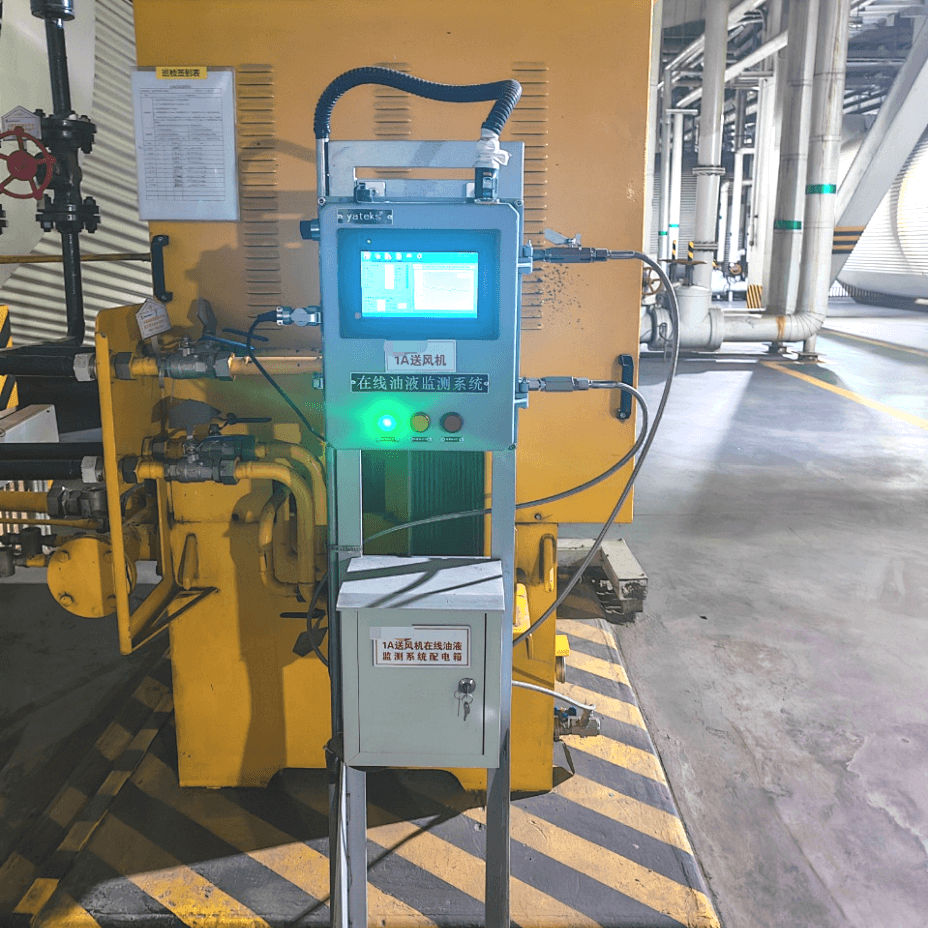
Online monitoring closes that gap. The unit is mounted directly on the fan’s hydraulic reservoir, sampling and displaying locally. A technician on the inspection round can read the oil’s vital signs at a glance, and a rising trend is caught in the first days rather than the next cycle.
Put simply, the retrofit moves oil assessment from sample, dispatch, wait to measure and read, on site.
Seven parameters, one continuous condition curve
The monitored fluid is ISO VG 46 hydraulic oil (grade 46# in the Chinese classification). Seven parameters are reported continuously:
|
Parameter
|
What it tells the operator
|
What deserves attention
|
|---|---|---|
|
Water content
|
Free water ingress, condensation, cooler leakage
|
A sustained rise over several days
|
|
Temperature
|
Oil temperature and how well heat is being shed
|
Abnormal highs, or wide swings
|
|
Mixed oils, external contamination
|
Drift away from the oil’s baseline
|
|
|
Cleanliness (particle count)
|
Particulate contamination: wear debris plus ingested dirt
|
A worsening ISO 4406 or NAS class
|
|
Kinematic viscosity
|
Oxidation and oil mixing
|
A clear rise or fall
|
|
Saturation (water saturation %)
|
How close the oil is to saturation
|
A rising trend, which precedes free water
|
|
Dielectric constant
|
Combined effect of moisture and degradation
|
A sudden change
|
The point of seven readings is not seven numbers. It is one continuous condition curve instead of a single lab slip.
Trend matters more than any single value. An individual reading can look acceptable while three days of steady climb already tell you something is moving. Alarm thresholds should be set from the OEM specification together with this machine’s own baseline; a generic threshold set copied across units and oil types will either cry wolf or stay silent.
Where the sensors go, and how the work was sequenced
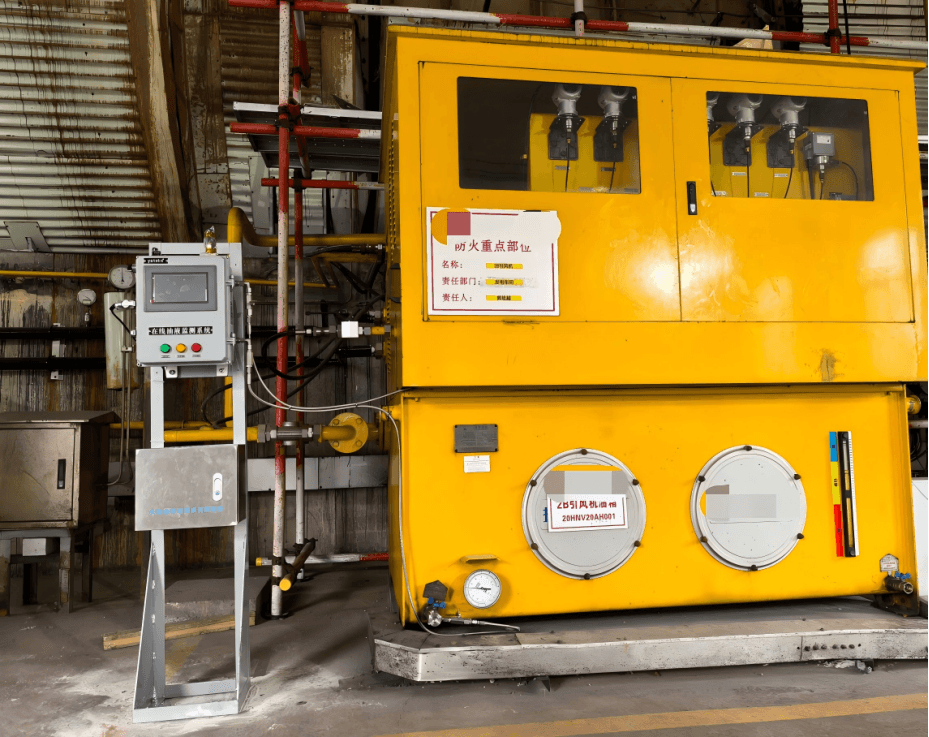
The mounting point on all three fans was the hydraulic reservoir side. That location was chosen deliberately: it is both the oil access point and a stop on the inspection round. A sensor installed where people already walk gets read every day; one installed out of the way gets read during the next audit.
Each fan went through the same three-step sequence — sensor mounting, cable routing, and system commissioning — interleaved with the overhaul schedule rather than appended to it.
What changed on the floor
Since commissioning, oil monitoring is no longer a task that has to be scheduled. It sits inside the inspection round.
For a critical machine, moving the laboratory next to the equipment means turning after-the-fact judgement into a process that stays under control. From waiting for a report to reading a trend, from periodic sampling to continuous awareness. That is the shift this retrofit bought.
Frequently asked questions
Does online oil monitoring replace laboratory sampling? No, the two are complementary. Online monitoring handles high-frequency trending and early warning; the laboratory handles high-accuracy confirmation and formal reporting. When the online data flags a change, a targeted lab check is far more efficient than sampling everything on a fixed calendar.
Where is the oil sensor mounted on a fan? The common location is the hydraulic reservoir side, as on the ID, FD and PA fans in this case — close to the oil, close to where people look, and clear of the fan’s own structure. The final position depends on available space, oil circuit layout and the inspection route.
Will a retrofit extend a maintenance outage? In this project the work was held to the rule of not extending the critical path, and was completed by interleaving with the overhaul before the unit went back into service. Actual duration depends on the number of machines, mounting points and site conditions.
Does this only work with ISO VG 46 hydraulic oil? ISO VG 46 hydraulic oil was the monitored fluid here. Sensors are configured to the oil type and operating conditions, and turbine oil, gear oil or insulating oil each need their own parameter set and calibration. Selection should follow the actual fluid in use.
Are seven parameters enough? That depends on the question you need answered. These seven cover the three main degradation paths — water, particulate contamination and viscosity — which is enough to support day-to-day decisions on whether the oil can stay in service, needs changing, or needs its source investigated. Wear-metal analysis and root-cause work still require laboratory spectroscopy or ferrography.
Next step
A critical fan’s sample spends days in transit, in a queue, and in a report — while the machine keeps running at full load.
If slow laboratory turnaround is a live issue on your site, send us these four details: fan type and count, oil in use, running hours and inspection practice, and your current sampling interval. Yateks will propose the matching online oil monitoring configuration.