
An oil sample tells you what your lubricant looked like on the day it was pulled. Everything that happened between that sample and the next one — a cooler leak, a seal starting to weep, an oil charge quietly oxidizing under heat — stays invisible until the next bottle comes back from the lab.
An oil quality sensor closes that gap. Mounted in the oil circuit, it reads the oil’s condition continuously and turns lubricant health into a data stream your maintenance team can act on, instead of a report that arrives two weeks late.
This guide covers what an oil quality sensor actually measures, where it fits in a condition-based maintenance program, and how the Yateks YTS-D-1 is specified for real plant conditions.
The short version: dielectric constant is a composite indicator. It moves when water, wear particles, acid build-up or oxidation enter the oil — which means one sensor gives you a trend line for overall oil degradation, not just a single contaminant. Pair it with a dedicated moisture sensor when you need to separate water from everything else.
What Does an Oil Quality Sensor Measure?
Most oil condition monitoring sensors on the market track one parameter. Water-in-oil sensors track moisture. Particle counters track contamination class. Viscosity sensors track film thickness behavior.
A dielectric constant sensor takes a different approach. It measures how the oil responds to an electric field, and that response shifts as the oil’s chemistry changes.
In clean, fresh lubricant the dielectric constant sits at a known baseline. As the oil ages, that baseline drifts:
- Water ingress raises the reading — water has a far higher dielectric constant than hydrocarbon oil
- Wear particles — iron, copper, silicon — change the effective dielectric properties of the fluid
- Acid and base value shifts from oxidation move the reading as the additive package depletes
- Soot and sludge in engine and gear oils push it further

Because several failure modes converge on the same signal, the dielectric channel works as an early-warning index for the oil as a whole. It will not tell you which contaminant arrived. It tells you something changed, and it changed now — which is exactly what you need to justify pulling a sample, inspecting a seal, or scheduling a filter change.
The Yateks YTS-D-1 measures two channels: oil quality (dielectric constant), 1–6 range at ±3%, and temperature, −40 to 120 °C at ±0.3 °C. Accuracy figures are the average of repeated static measurements in a lab environment; field conditions introduce deviation, which is why trending matters more than any single reading.
Why temperature is part of the same sensor?
Oil quality readings are temperature-dependent. A dielectric value at 30 °C and the same value at 80 °C do not mean the same thing. Measuring temperature on the same probe lets the system normalize readings and lets your PLC apply thresholds that hold steady across warm-up, load swings and seasonal ambient changes. A quality sensor without a temperature channel leaves that correction to you — usually in a spreadsheet, usually after the fact.
Water in Oil: Dissolved, Free, and Why the Distinction Matters
Water is the most common contaminant in lubricating and hydraulic oil, and it is damaging well before it becomes visible.
Oil holds water in three states:
| State | What it looks like | What it does |
|---|---|---|
| Dissolved | Invisible; oil looks normal | Saturation approaching; film strength already dropping |
| Emulsified | Milky, hazy | Bearing corrosion underway; additives being consumed |
| Free | Separate water layer or droplets | Corrosion, pitting, hydrogen embrittlement risk at full level |
The saturation point — the maximum dissolved water an oil can hold before free water appears — moves with temperature, base oil type, and oil age. That is why a “percent water” number on a lab report is less useful than it looks: the same 300 ppm is harmless in one oil at one temperature and near the limit in another.
Two practical consequences for sensor selection:
- A dielectric constant sensor sees water early, because dissolved water already shifts the reading — before the oil turns milky.
- A dielectric sensor cannot quantify water in ppm. If your program needs a moisture number for a spec limit, add a dedicated moisture channel.
Yateks splits this deliberately across the product line:
- YTS-M-1 moisture content sensor — targets dissolved water in oil, for early saturation warning
- YTS-W-1 water content sensor — targets free and emulsified water, for contamination that has already progressed
- YTS-D-1 oil quality sensor — dielectric constant plus temperature, for the overall degradation trend
Running YTS-D-1 alongside a moisture sensor gives you both the “something is wrong” signal and the “here is how much water” number, without paying for a full laboratory instrument on every machine.
From Fixed Oil Changes to Condition-Based Maintenance
Most lubrication programs still run on the calendar. Oil gets changed at 2,000 hours because the OEM manual says 2,000 hours — not because the oil needed it.
| Approach | When work happens | What it costs you |
|---|---|---|
| Reactive | After failure | Unplanned downtime, collateral damage, expedited parts |
| Planned / preventative | Fixed intervals from OEM guidance | Good oil discarded, bad oil kept too long, faults born between intervals |
| Condition-based (CBM) | When the data says so | Requires instrumentation and a baseline; rewards you with fewer interventions and longer asset life |
Condition-based maintenance only works if the condition data is continuous. A quarterly lab sample is a preventatively-scheduled inspection wearing a CBM costume. A sensor polling once a second is the real thing.
What a usable CBM loop looks like?
- Establish a baseline. Log the dielectric value and temperature on known-good oil, at operating temperature, over a full load cycle. Two weeks of data beats one spot reading.
- Set a trend alarm, not a hard trip. Alarm on rate of change relative to the baseline, plus an absolute ceiling. A slow drift over six weeks means oxidation or additive depletion. A step change in one shift means a leak or a seal failure.
- Tie the alarm to an action. Every threshold should map to a defined response: pull a sample, inspect the breather, check the cooler, schedule a filter change.
- Close the loop with lab confirmation. The sensor tells you when to sample. The lab tells you what the sample contains. Together they replace guesswork on both ends.
YTS-D-1 Oil Quality Sensor: Specification and Installation
The YTS-D-1 is built for inline installation in industrial oil circuits, with a probe designed for dirty service and a stainless housing that tolerates chemical exposure and pressure.
| Item | Specification |
|---|---|
| Measurement channels | Oil quality (dielectric constant) 1–6; temperature −40 to 120 °C |
| Accuracy | Oil quality ±3%; temperature ±0.3 °C (at 25 °C) |
| Output | RS485 Modbus RTU (standard); CAN 2.0B (optional); 4–20 mA (optional) |
| Refresh rate | Once per second |
| Supply | DC 12–32 V (RS485); DC 20–32 V (4–20 mA) |
| Media | Lubricating oil, hydraulic oil, gear oil, engine oil, fuel oil, insulating oil, turbine oil, synthetic esters, light and heavy oils |
| Mounting | Direct probe installation in the oil circuit; threaded body with defined probe geometry |
Integration notes from the field. Modbus RTU over RS485 is the path of least resistance into a PLC, a SCADA historian, or a condition monitoring dashboard — no proprietary gateway. The 4–20 mA option exists for plants standardizing on analog loops. One reading per second is far more than trend analysis needs, but it matters for catching step changes during a flushing cycle or a filter bypass event.
Where it goes
| Application | What the sensor catches |
|---|---|
| Hydraulic power units and presses | Water ingress from cooler leaks, seal weep, cylinder rod seal failure |
| Industrial gearboxes | Oxidation trend, particle build-up, oil change timing |
| Turbines and turbo-compressors | Slow degradation between scheduled samples |
| Machine tool and injection molding hydraulics | Contamination events after maintenance work |
| Marine and offshore machinery | Coolant and sea water ingress in engines, thrusters and deck hydraulics |
| Wind turbine gearboxes | Oil aging under thermal cycling, remote visibility without a site visit |
| Transformer and insulating oil | Moisture-driven loss of dielectric strength — early warning |
| Test rigs and tribology labs | Continuous condition logging alongside wear measurements |
For marine and offshore users, the same logic applies on the water side of the machine: a seal that lets water into the oil circuit is often letting oil into the cooling water at the same time. Monitoring both sides of that boundary is how you catch a failing heat exchanger before it becomes a both-fluids problem.
Single sensor vs full monitoring system
YTS-D-1 is the entry point. When an asset justifies a wider view, the same plant can step up to a multi-parameter build:
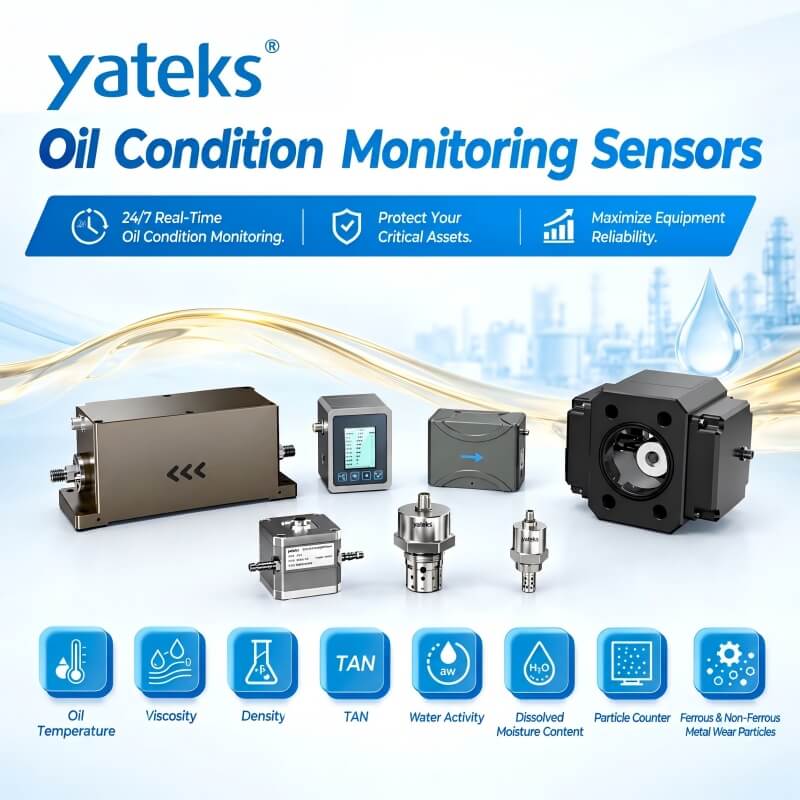
- YTS61 6-in-1 oil condition sensor — viscosity, density, dielectric constant, water activity, moisture content and temperature in one probe
- YOL online oil condition monitoring system — an integrated cabinet combining quality, moisture, particle counting and wear debris channels, with local display and cloud reporting
Yateks has documented this system running on the oil flushing and cleaning line of a ship power equipment manufacturer, where continuous quality and contamination data replaced end-of-line sampling. The same architecture scales down to a single press and up to a multi-machine plant.
How to Specify an Oil Quality Sensor Without Overbuying
Five questions decide most of the specification:
- Is your priority an early-warning index or a quantified contaminant? Trend index → dielectric sensor. Water limit compliance → dedicated moisture sensor. Both → two channels.
- What is the oil temperature at the probe? Confirm the sensor’s rated range covers your operating window with margin, including warm-up transients.
- How does the signal reach your control layer? Modbus RTU, 4–20 mA or CAN. Choose based on what your PLC or historian already speaks.
- Where is the probe installed? Dead-legs and low-flow pockets give you stale readings. Install in active flow, downstream of the pump, upstream of the filter if you want to see incoming contamination.
- Who owns the alarm threshold? Define the baseline and the action before commissioning, not after the first nuisance alarm.

Frequently Asked Questions
What is an oil quality sensor? An oil quality sensor continuously measures a property of lubricating or hydraulic oil that changes as the oil degrades. The Yateks YTS-D-1 measures dielectric constant and temperature, producing a real-time trend of overall oil condition without lab turnaround.
Can a dielectric constant sensor detect water in oil? Yes, at the earliest stage. Dissolved water shifts the dielectric reading before free or emulsified water becomes visible. It gives you an early warning, not a ppm value — use a dedicated moisture sensor such as YTS-M-1 when you need a quantified water number.
How is this different from sending oil samples to a lab? Sampling is periodic and retrospective; the sensor is continuous and current. The two are complementary: the sensor tells you when a sample is worth taking, and the lab tells you exactly what that sample contains.
Will the sensor work with synthetic lubricants? Yes. The YTS-D-1 is specified for mineral and synthetic oils, including synthetic esters, plus hydraulic, gear, turbine, engine, fuel and insulating oils. Baseline values differ between oil types, so commission each oil grade separately.
What output do I need for my PLC? RS485 Modbus RTU is standard and covers most PLCs, SCADA systems and historians directly. CAN 2.0B and 4–20 mA are available as options for plants with existing analog or CAN infrastructure.
How often does the reading update? Once per second. That is more resolution than trend analysis requires, and it is enough to catch step changes during flushing, filter bypass or a sudden seal failure.
Can it run unattended? Yes. The sensor is passive once installed and requires no manual sampling. Cleaning and inspection intervals depend on oil condition and duty cycle — the probe geometry is designed to be straightforward to clean in place.
Instrument the Oil, Not the Calendar
You already know which assets hurt when they stop. Those are the ones that justify a sensor.
Yateks has been building oil analysis instruments and online oil condition sensors since 2003, with products in service across 59 countries in large-equipment monitoring, IIoT, transportation and aerospace applications.
Next step: send us the oil type, operating temperature, circuit pressure and the control platform you are integrating with, and we will confirm the right sensor configuration — YTS-D-1 alone, or YTS-D-1 paired with a moisture channel.