
In hydraulic systems, gearboxes, lubrication circuits and large-scale industrial machinery, hydraulic oil and lubricating oil serve multiple critical functions. They deliver lubrication, power transmission and heat dissipation. Beyond these roles, oil acts as a “window” reflecting the internal health of equipment. For example, solid contaminants such as metallic wear debris and dust can infiltrate the oil. They speed up abnormal wear on gears, bearings and valve assemblies. This may trigger unexpected downtime and heavy economic losses.
Real-time monitoring of oil cleanliness and early detection of abnormal wear are essential. They support equipment condition monitoring and predictive maintenance. Online oil contamination sensors are the core hardware for continuous oil monitoring.
What Is an Oil Contamination Sensor?
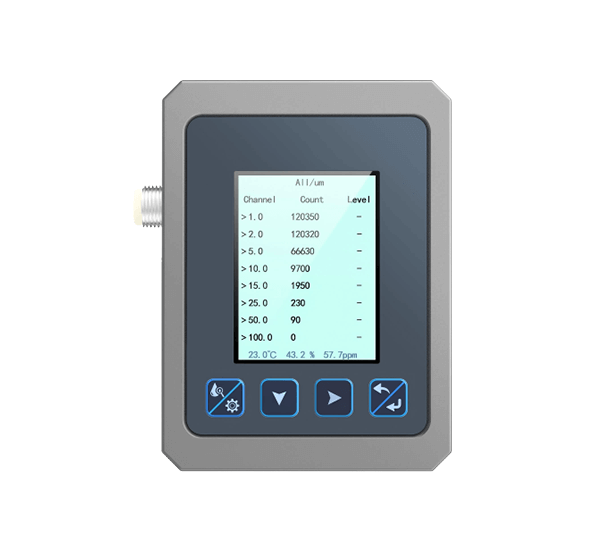
An oil contamination sensor is also called an online oil particle counter. It continuously counts solid particles in oil and measures their size distribution. It calculates contamination levels following widely accepted industrial standards.
Online oil contamination sensors deliver 24/7 continuous data acquisition. They eliminate blind gaps between periodic samples, unlike traditional manual sampling and lab testing. Engineers widely deploy these sensors in wind power, metallurgy, petrochemical, power generation and other continuously operating industrial assets.
Maintenance teams use global standards to quantify oil cleanliness. Common standards include ISO 4406-2021, NAS 1638, GOST 17216-2001 and SAE AS4059G. Once they establish this baseline, maintenance engineers track particle trends across different size bins. They identify oil degradation and decide if filtration, oil change or further inspection is needed.
Working Principle of Oil Contamination Sensors | Laser Obscuration Particle Counting
Take Yateks YFJ‑4 online oil particle sensor as an example. It adopts the proven single laser obscuration counting technology, a mature and reliable solution for industrial online particle measurement.
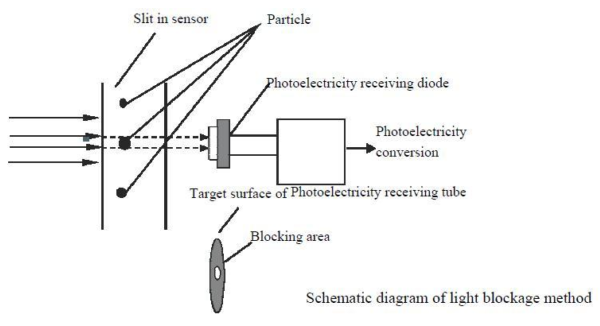
Oil flows at a stable rate through the sensor measuring chamber. A collimated laser beam irradiates the flow channel. When suspended particles pass through the laser detection zone, they block light and reduce light intensity. Photoelectric detectors capture these light signal variations. Based on signal attenuation amplitude and pulse duration, the system calculates particle size and counts particles, outputting multi‑channel particle size distribution data.
Industrial sites are prone to interferences such as air bubbles, flow fluctuation and electrical noise. The YFJ‑4 series integrates dedicated waveform recognition algorithms and intelligent digital filtering to suppress false bubble triggers, improving small‑particle detection capability and long‑term data stability. Its measurable range covers 1–100 μm with multiple counting channels, suitable for most industrial lubrication and hydraulic oil monitoring applications.
Simplified logic: Particles block laser → photoelectric signal changes → algorithm classifies particle size & counts particles → automatic oil contamination rating.
Why Online Oil Contamination Monitoring? Are Periodic Oil Samples Sufficient?
Traditional oil analysis relies on discrete periodic sampling. Monitoring blind spots exist between sampling events. As a result, sudden contamination or rapid component wear occurring in the interval may not be discovered until the next lab report. By then, irreversible damage may have already occurred, leaving teams unable to seize the optimal early maintenance window.
Installing online oil contamination sensors generates continuous time‑series curves, helping engineers interpret equipment signals clearly:
Steady increase in total particle count: External ingression or degraded filter cartridges
Sharp spike in large‑size particles: Abnormal wear on gears or bearings, trigger high‑priority alerts
Reduced contamination difference across filter inlet/outlet: Filter blocked or failed, replacement required
Gradually worsening long‑term trend: Combined oil ageing and continuous wear; schedule planned oil service
The core value of online monitoring is not merely outputting a single contamination value. It upgrades discrete spot checks into continuous condition awareness, shifting maintenance strategy from breakdown repair to early warning.
Application Scenarios: Online Oil Monitoring for Hydraulics, Gearboxes & Heavy‑Duty Assets
- Wind Turbine Gearboxes Gearboxes are high‑value wind farm components with extremely high downtime costs. Online oil contamination sensors track rising wear debris trends to detect early gear pitting and bearing wear, cutting unplanned outages.
- Hydraulic Systems (Construction Machinery, Metallurgical Hydraulic Stations) Hydraulic valves and piston pumps are highly sensitive to oil cleanliness. Online monitoring quickly identifies contamination caused by seal failure, dust ingress or faulty filters to protect precision hydraulic components.
- Steel, Petrochemical, Power, Cement & Other Heavy Industries Combine particle contamination data with oil temperature, water content, viscosity and other parameters via multi‑sensor systems to build a comprehensive oil health assessment platform.
Yateks YFJ‑4 oil contamination sensors support multiple pipeline mounting configurations. Customised installation schemes can be delivered according to existing oil circuit layout, flow conditions and monitoring points for seamless integration into control systems.
Industry Trend: Oil Monitoring Shifts from Periodic Sampling to Continuous Sensing to Enable Predictive Maintenance
Driven by industrial digitalisation, oil contamination monitoring is evolving beyond isolated data collection.
With continuous particle data captured by online oil contamination sensors, correlated with operational parameters, oil physicochemical properties, water content and wear indicators, equipment health trend models can be constructed. This closes the monitoring loop: detect oil contamination → trace root causes → recommend maintenance actions.
For this reason, for critical assets where shutdown costs are prohibitive, deploying an online oil monitoring system speeds up fault alerts, cuts over‑maintenance and lowers total OPEX. This makes it a key enabler for practical predictive maintenance
If you are looking for high‑performance online oil contamination sensors or complete oil particle monitoring solutions, please contact Yateks.