
Introduction: From Reactive Maintenance to Predictive Maintenance
In modern industrial operations, equipment reliability directly affects productivity, operating costs, and business performance. For critical machinery such as wind turbines, hydraulic systems, gearboxes, engines, and industrial equipment, lubrication plays a vital role in ensuring smooth operation.
Lubricating oil is often described as the “blood” of industrial machinery because it reduces friction, transfers heat, prevents corrosion, and protects mechanical components.
However, traditional maintenance strategies often rely on fixed oil change intervals or periodic laboratory analysis. These methods may not accurately reflect the real-time condition of the oil or the actual health status of the equipment.
Today, real-time oil condition monitoring systems for industrial equipment are transforming maintenance strategies by helping companies continuously track lubricant health, detect abnormal conditions, and prevent unexpected failures.
What Is Oil Condition Monitoring?
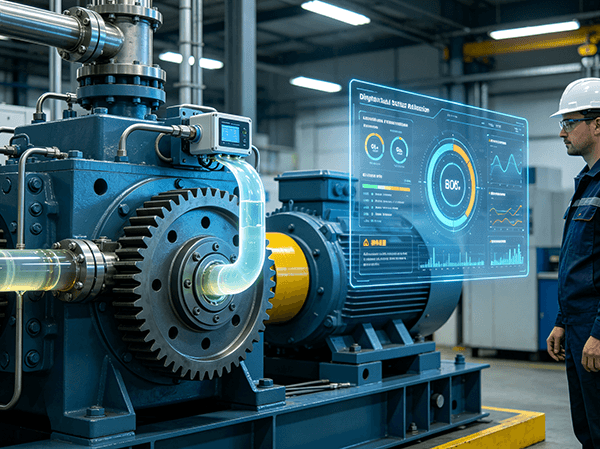
Oil condition monitoring is an advanced technology that uses intelligent sensors installed directly into equipment lubrication systems to continuously measure the physical and chemical properties of lubricating oils.
Unlike traditional oil analysis, which requires manual sampling and laboratory testing, an online oil monitoring system provides real-time data without interrupting equipment operation.
By continuously analyzing oil parameters, companies can understand:
- Oil degradation level
- Lubrication performance
- Contamination status
- Equipment wear conditions
- Potential failure risks
In simple terms:
An industrial oil condition monitoring system uses advanced sensors installed directly into lubrication circuits to measure oil properties without manual sampling.
Why Is Real-Time Oil Monitoring Important?
Industrial equipment failures are often preceded by small changes in lubricant conditions.
Before a gearbox fails, before a hydraulic system loses efficiency, or before a bearing becomes damaged, the oil usually shows early warning signals.
These signals include:
- Increasing moisture content
- Abnormal viscosity changes
- Rising contamination levels
- Oil oxidation
- Additive depletion
By detecting these changes early, maintenance teams can take preventive action before costly downtime occurs.
Key Parameters Measured by Oil Condition Sensors
A modern oil condition sensor for predictive maintenance can continuously analyze lubricant parameters and provide valuable insights into machine health.
1. Viscosity Monitoring
Viscosity is one of the most important properties of lubricating oil.
It determines whether the oil can maintain sufficient lubrication and create a protective film between moving components.
Changes in viscosity may indicate:
- Oil aging
- Oxidation
- Fuel contamination
- Water contamination
- Excessive temperature exposure
Real-time viscosity monitoring helps ensure that lubricants continue to provide effective protection.
2. Dielectric Constant Monitoring
The dielectric constant is an important indicator of oil condition changes.
As oil becomes contaminated or oxidized, its electrical properties change.
Monitoring dielectric constant can help identify:
- Oil oxidation
- Additive depletion
- Water contamination
- Overall oil degradation
This provides valuable information for determining whether oil replacement or maintenance is required.
3. Moisture and Water Content Detection
Water contamination is one of the biggest threats to industrial lubrication systems.
Excess moisture can cause:
- Bearing corrosion
- Reduced lubrication performance
- Oil emulsification
- Accelerated component wear
An online moisture sensor allows operators to detect water contamination before serious damage occurs.
4. Temperature Monitoring
Operating temperature has a direct impact on oil life.
High temperatures accelerate:
- Oil oxidation
- Additive breakdown
- Lubricant degradation
Continuous temperature monitoring helps identify abnormal operating conditions and prevent premature oil failure.
5. Particle and Contamination Monitoring
Wear particles generated from gears, bearings, and other components can provide early indications of mechanical problems.
Increasing contamination levels may suggest:
- Abnormal component wear
- Internal damage
- Poor filtration performance
By monitoring contamination trends, maintenance teams can identify developing problems before equipment breakdown.
Benefits of Online Oil Monitoring Systems
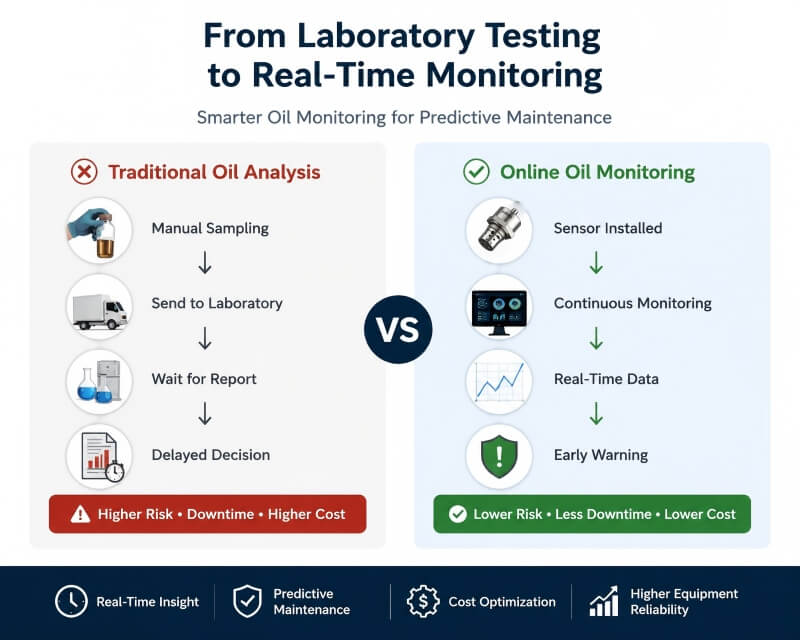
1. Reduce Dependence on Laboratory Oil Analysis
Traditional oil testing requires:
- Manual sampling
- Transportation to laboratories
- Testing process
- Waiting for analysis reports
This approach may delay decision-making.
With an online oil condition monitoring system, companies can achieve:
- Continuous 24/7 monitoring
- Real-time data collection
- Immediate abnormal condition detection
This is especially valuable for critical equipment operating in remote or harsh environments.
2. Early Fault Detection and Predictive Maintenance
Oil condition changes often happen before mechanical failures occur.
For example:
Increasing moisture
- Oil contamination
- Reduced lubrication performance
- Increased corrosion risk
Rising particle concentration
- Component wear
- Mechanical damage risk
- Possible equipment failure
Abnormal dielectric changes
- Oil oxidation or contamination
- Lubrication degradation
By analyzing these trends, companies can move from reactive maintenance to predictive maintenance.
3. Optimize Oil Change Intervals
Many companies replace oil based on fixed schedules.
However, actual oil life depends on:
- Operating conditions
- Load levels
- Temperature
- Contamination environment
Fixed oil replacement may result in:
- Unnecessary oil consumption
- Increased maintenance costs
- Reduced sustainability
With real-time oil quality monitoring, companies can perform condition-based maintenance and replace oil only when necessary.
Applications of Oil Condition Monitoring Technology
Wind Turbine Gearbox Monitoring
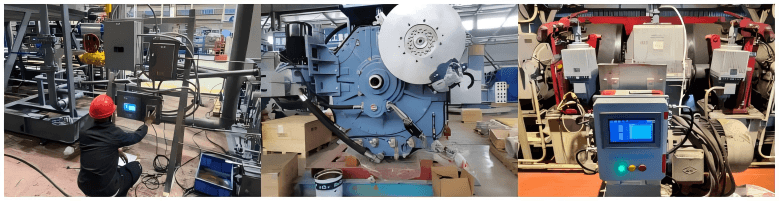
For wind turbine gearbox applications, an online oil quality monitoring system for gearbox protection helps operators track viscosity changes, moisture levels, contamination, and oil degradation in real time.
Continuous monitoring of:
- Viscosity
- Moisture
- Contamination
- Oil degradation
helps operators detect lubrication problems early and reduce unexpected downtime.
Hydraulic System Monitoring
Hydraulic equipment requires clean and stable oil conditions.
Oil sensors help monitor:
- Hydraulic fluid quality
- Contamination levels
- Temperature changes
to improve system reliability.
Industrial Machinery and Manufacturing Equipment
Production equipment often operates continuously, making unexpected failures extremely costly. In factories and heavy industries, oil sensors for machinery health monitoring provide continuous information about lubrication conditions and equipment performance.
Online oil monitoring provides valuable data for:
- Factory automation systems
- Gear drives
- Compressors
- Pumps
- Heavy machinery
Marine and Power Generation Equipment
Large engines and generators require reliable lubrication management.
Real-time oil condition monitoring helps maintain operational efficiency and extend equipment service life.
Yateks YTS61: Advanced 6-in-1 Oil Condition Sensor
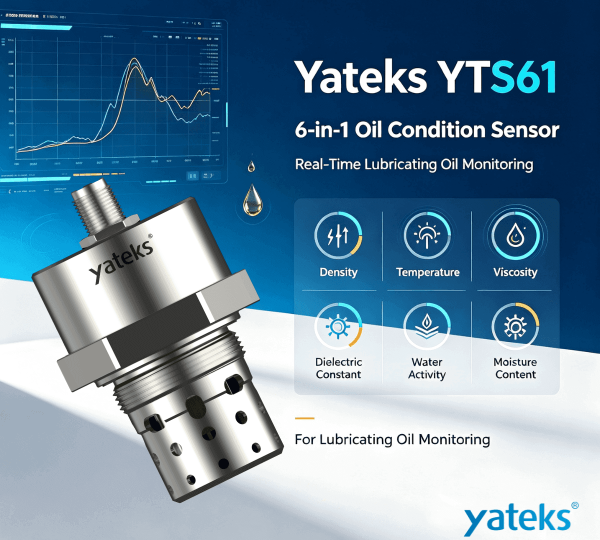
To meet the growing demand for intelligent predictive maintenance, Designed as an advanced multi-parameter oil condition monitoring sensor, Yateks YTS61 helps industries achieve continuous lubricant monitoring and smarter predictive maintenance.
- Density
- Temperature
- Viscosity
- Oil quality(Dielectric Constant )
- Water Activity (humidity/saturation)
- Moisture Content
By providing continuous oil condition data, YTS61 helps industries better understand lubricant performance, improve maintenance decisions, and enhance equipment reliability.
The Future of Industrial Maintenance: Data-Driven Oil Monitoring
As industries move toward digital transformation and smart manufacturing, traditional maintenance methods are gradually being replaced by data-driven solutions.
Oil is no longer just a consumable lubricant — it is a valuable source of information about machine health.
With advanced oil condition monitoring sensors, companies can achieve:
- Real-time insights into equipment operating conditions
- Early detection of abnormal machine behavior
- Cost savings through predictive maintenance strategies
- Longer service life for industrial assets
- More reliable and efficient operations
Whether used for wind turbine gearboxes, hydraulic systems, or industrial machinery, online lubricant monitoring solutions help companies improve reliability, reduce downtime, and optimize maintenance strategies.