
In modern industrial operations, maintaining optimal oil quality is crucial for ensuring equipment reliability, operational efficiency, and environmental compliance. Oil quality monitoring sensors play a vital role in real-time assessment and management of lubricants, fuels, and other oil-based fluids. These advanced devices provide valuable insights into physical, chemical, and performance characteristics, enabling proactive maintenance and smarter decision-making.
Key Oil Quality Monitoring Sensors
A wide range of sensors is available to monitor various oil parameters, each designed to address specific quality and safety concerns:
Viscosity Sensors – Measure flow characteristics to ensure proper lubrication and efficiency.
Density Sensors – Assess mass and energy density for quality evaluation.
Temperature Sensors – Monitor thermal conditions to prevent overheating and degradation.
Moisture Sensors – Detect water content to avoid corrosion and oxidation damage.
Acidity (TAN) Sensors – Evaluate acid levels to gauge oil stability and lifespan.
Oxidation Stability Sensors – Test resistance to degradation under high temperature and pressure.
Sulfur Content Sensors – Ensure compliance with environmental regulations.
Particle Count Sensors – Monitor contamination levels for system cleanliness.
Flash Point Sensors – Determine flammability for safety management.
Conductivity Sensors – Measure impurity and ion content.
Odor Sensors – Identify unusual smells indicating contamination.
Optical Sensors – Assess color and clarity for visual quality checks.
pH Sensors – Monitor acidity or alkalinity.
Oxygen Content Sensors – Track oxidation levels in real time.
These sensors can be used individually or integrated into a complete oil monitoring system, tailored to specific industrial needs and environmental conditions.
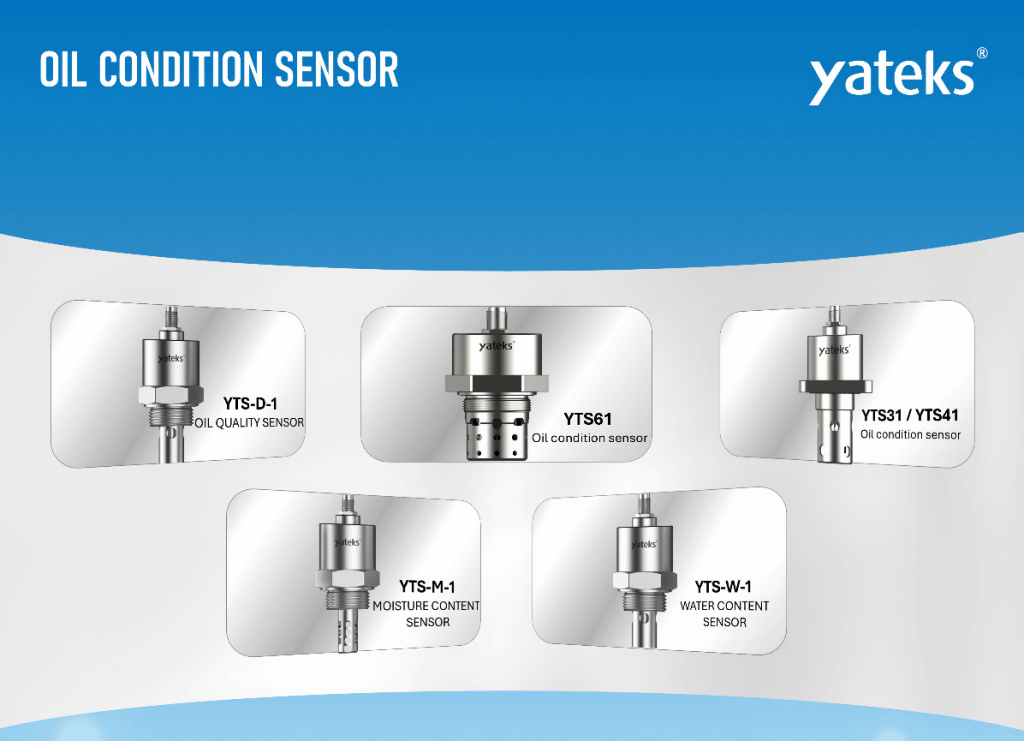
Discover our range of high-performance oil sensors here: Oil Quality Sensors
The Role of Oil Sensors in Industrial Operations
Oil monitoring sensors deliver actionable data that enhances operational control and predictive maintenance:
Real-Time Insights – Instant feedback on oil condition enables quick response to potential issues.
Quality Assurance – Continuous tracking of viscosity, moisture, acidity, and contamination ensures adherence to standards.
Performance Optimization – Data on temperature, cleanliness, and flow supports efficiency improvements.
Predictive Maintenance – Early detection of abnormalities helps prevent equipment failure.
Energy Savings – Optimized oil performance reduces power consumption.
Environmental Compliance – Monitoring of sulfur, oxidation, and emissions supports regulatory adherence.
Safety Enhancement – Flash point and odor detection minimize fire and health risks.
Remote Monitoring – Integrated systems allow off-site access and control.
By enabling smarter maintenance schedules and reducing downtime, oil sensors significantly lower operational costs while extending equipment life.
How Oil Monitoring Sensors Work
Each sensor employs specialized technology to translate oil properties into usable data:
Viscosity Sensors – Use oscillation, capacitance, or pressure drop principles.
Density Sensors – Operate via buoyancy or vibrational frequency changes.
Moisture Sensors – Rely on capacitive, resonant, or infrared detection.
Acidity Sensors – Utilize electrochemical or optical methods.
Particle Sensors – Apply optical, resistive, or laser scattering techniques.
Flash Point Sensors – Use open-cup and ignition source testing.
These technologies ensure accurate, reliable monitoring tailored to diverse industrial environments.
Upgrade your operations with intelligent oil monitoring solutions. Whether in manufacturing, energy, transportation, or heavy machinery, our sensors provide the precision and reliability needed to protect your assets, enhance safety, and promote sustainability.

Explore Our Oil Sensor Solutions Today